If you run an excavator on a Sydney job site, the honest answer to “how often should it be serviced?” is: more often than most maintenance stickers suggest, and always by the hour meter rather than the calendar. An excavator earning its keep on a busy site can rack up 40–50 hours a week — which means a “quarterly” service schedule can quietly turn into a 600-hour gap between visits. That’s how minor issues (a clogged filter, a slow hydraulic leak, a fault code nobody chased up) turn into a cracked track roller, a blown hydraulic pump, or a machine that won’t start on a Monday morning.
Here’s the servicing schedule we work to, why each interval matters, and what happens if it slips.
Service Intervals by the Hour, Not the Month
Every manufacturer — Caterpillar, Kubota, Hitachi, Kobelco, Bobcat and the rest — builds their service schedules around engine hours, not weeks or months. As a general guide across most mini and standard excavators:
Daily (every 8–10 hours) Walk-around check: engine oil level, coolant level, hydraulic fluid level, fuel/water separator, grease points on the boom, arm and bucket pins, undercarriage condition, and a visual check for leaks. Takes ten minutes and catches problems before they become breakdowns.
Every 50 hours Grease all pivot points thoroughly, check track tension, inspect air filter, check battery terminals and belt condition.
Every 250 hours Change engine oil and filter, replace fuel filters, check hydraulic filter, inspect and adjust track tension, check final drive oil levels, inspect cooling system hoses and clamps.
Every 500 hours Everything in the 250-hour service, plus hydraulic oil sampling, replace hydraulic filters, check swing gear oil, inspect and adjust valve clearances (engine-dependent), test coolant condition.
Every 1,000–2,000 hours Major service: hydraulic oil change, final drive oil change, swing gear oil change, comprehensive undercarriage inspection, injector and turbo checks, and a full diagnostic scan for stored fault codes.
If your excavator sits idle for long stretches between jobs, time-based intervals matter too — fuel degrades, seals dry out, and batteries drain even when the machine isn’t earning. As a rule of thumb, service on whichever comes first: the hour interval or six months, since idle time causes its own wear.
Why This Schedule Gets Skipped
On a live site, servicing is easy to defer. The machine is running fine, there’s a deadline, and a 250-hour service feels like it can wait until next week. The problem is that a lot of excavator failures don’t announce themselves early — a slow hydraulic leak, a dirty fuel filter causing intermittent power loss, or a wiring fault throwing an intermittent code are all things that look fine right up until the machine doesn’t start, loses power mid-dig, or a hydraulic cylinder fails on-site. We’ve seen all three this year on machines that were otherwise well looked after — just overdue.
The other reason services get skipped is logistics: booking a machine into a workshop means a flatbed, a day (or more) of downtime, and a service history spread across whoever was available that week. That’s the gap mobile servicing is built to close.
What Skipping a Service Actually Costs
A missed 250-hour service is a cheap oversight. A missed service that leads to a seized final drive, a burnt-out hydraulic pump, or an engine rebuild is not — and it usually comes with a week or more of the machine sitting idle instead of earning. On a Sydney job site, an excavator down for even a day can hold up excavation, delay concrete pours, and put every trade behind it off schedule. Regular servicing is the cheapest insurance against that kind of week.
Mobile Servicing Across Greater Sydney
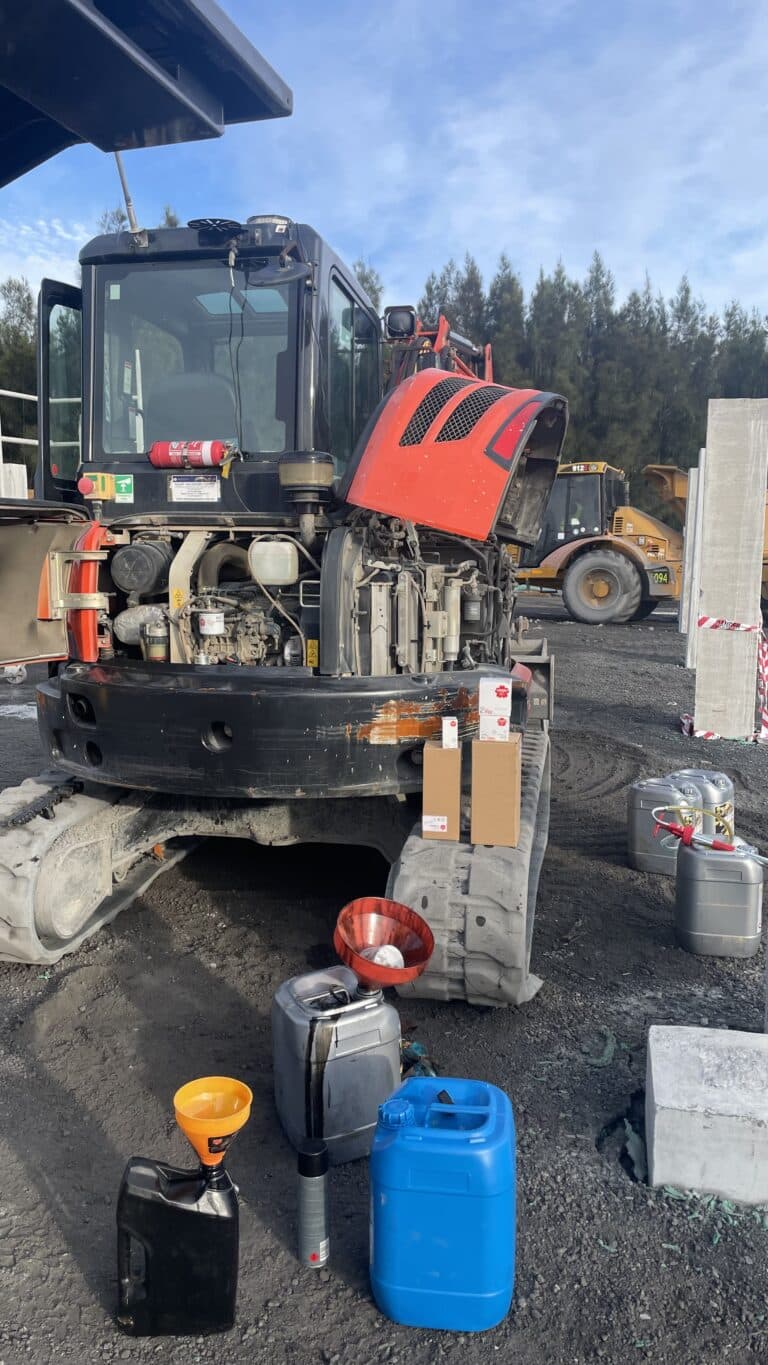
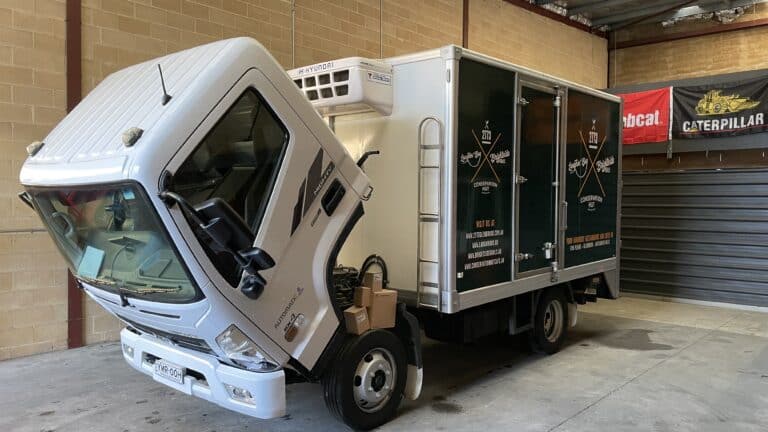
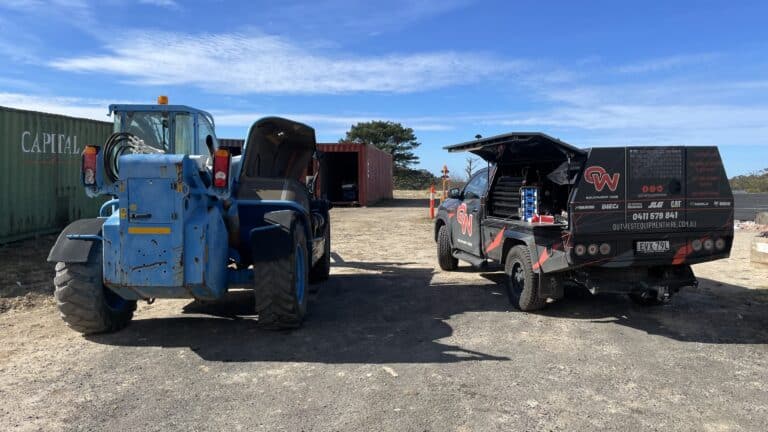
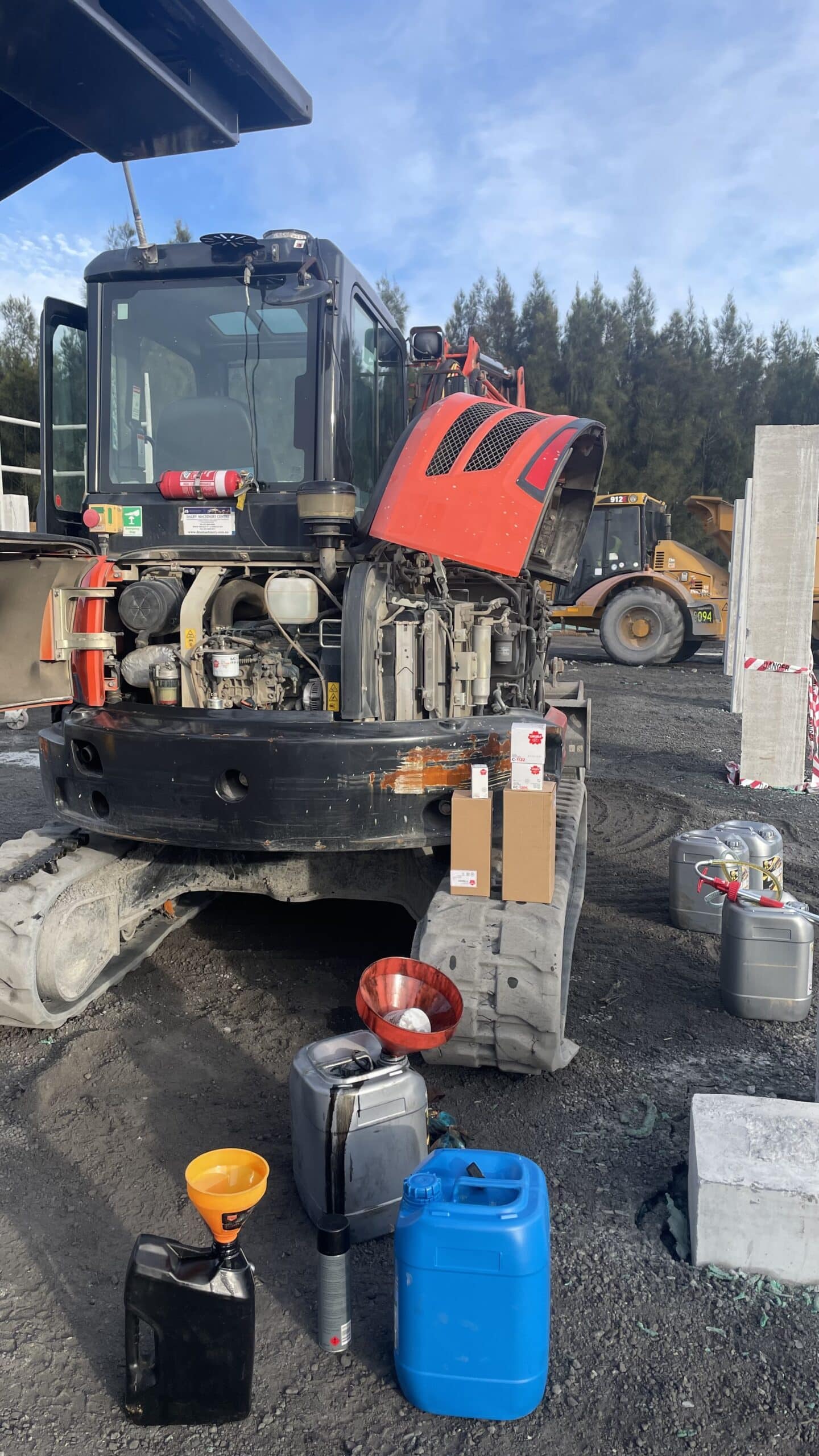
We service excavators (along with skid steers, forklifts, telehandlers, boom lifts, scissor lifts, and heavy trucks) on-site, across greater Sydney, on brands including Caterpillar, Kubota, Hitachi, Kobelco and Bobcat. Our service vehicles carry stock parts, so most call-outs are one visit, not two — and we typically get to site within around two hours of a call. No flatbed, no waiting on a workshop slot, and your machine stays where the job is.
If it’s time for a scheduled service, or something on your excavator isn’t quite right, get in touch and we’ll get a mechanic to your site.
FAQs
How many hours between excavator services? As a general guide: daily checks, a proper service every 250 hours, and a major service every 1,000–2,000 hours. Exact intervals vary by make and model — check your machine’s manual for the manufacturer-specified schedule.
Does an idle excavator still need servicing? Yes. Fuel, hydraulic fluid, and batteries degrade with time as well as use. If a machine has sat for six months or more, it should be checked before it goes back to work, even if it’s under its hour-based service interval.
Can excavator servicing be done on-site? Yes — most routine and mid-level servicing can be done on-site with a fully stocked service vehicle, without the machine leaving your job.
What’s the difference between a 250-hour and 1,000-hour service? A 250-hour service covers oil, filters, and inspection items. A 1,000+ hour major service adds hydraulic and final drive oil changes, swing gear oil, undercarriage inspection, and a full diagnostic check for stored fault codes.